
Home slider

Micro Additive Manufacturing (AM) at Accumold
Take advantage of micro AM for your next precision prototype. >> Learn More

CAPABILITY SCALABILITY SUSTAINABILITY®
Bring your ideal micro part design and let Accumold be your key to success.

40 years dedicated to micro molding and tooling
Accumold is your dedicated, proven, and truly vertically-integrated strategic product development partner.
Insights section
Insights

ACCUMOLD AT OFC 2026 – POWERING OPTICAL NETWORKING’S NEXT LEAP



3-columns Grid
Markets

Medical
Micro molding is the solution used by many medical device OEMs to achieve the precision required by their products or applications.

Micro Electronics
Accumold has 30 years experience working with OEMs that require complex micro-sized electronic components and connectors.

Polymer Optics
Micro manufacturing is pushing the boundary of what is possible in the area of micro-optic component manufacturing.

Emerging Tech
Our emerging technology experience is in components for smart devices or wearables, which is driven by weight, cost, and high-precision.

Automotive Electronics
The automotive industry is a driving force when it comes to innovation and development of micro-systems, with demand for high volume production.

CTA w/btn

What is Micro Molding?
Micro-molding is a highly specialized manufacturing process that produces extremely small, high-precision thermoplastic parts and components with micron tolerances.
The process starts in a tooling department where a mold is created that has a cavity in the shape of the part desired. Thermoplastic or resin is rapidly injected into the cavity, creating the component or part at high speed.
CTA w/background

Ask an Expert
Internal Header section

What is Micro Molding?
1/3 image 2/3 text
Micro-molding is a highly specialized manufacturing process that produces extremely small, high-precision thermoplastic parts and components with micron tolerances. The process starts in a tooling department where a mold is created that has a cavity in the shape of the part desired. Thermoplastic or resin is rapidly injected into the cavity, creating the component or part at high speed.

No matter how you spell it, micro molding, micromolding or even micro moulding, there is a lot of talk in engineering circles these days. This reflects the increased interest from designers and manufacturers in producing and procuring high-precision, micro-featured plastic parts. The result has been countless articles in trade magazines addressing this new niche in the injection molding industry containing many differing definitions, creating confusion. So exactly what is micro-molding? Part size is one of the obvious elements but is it the only element? Or is it simply defined by the size of the injection press? What about precision, or does the part just have to be small? At Accumold, we believe true micro molding involves much more than size or machine.
Two columns section
What about the size?
Obviously, the term “micro” suggests that micro-molding has something to do with size, but how is it defined?
When you speak of parts that weigh less than a gram, you’re in the right ballpark, but it takes more than size. It’s one thing to mold something small, it’s another thing to mold it efficiently and precisely time and time again. Micro molding must be capable of producing thousands, millions, even billions of parts with the same precision.
What about the machine?
Obviously, the term “micro” suggests that micro-molding has something to do with size, but how is it defined?
When you speak of parts that weigh less than a gram, you’re in the right ballpark, but it takes more than size. It’s one thing to mold something small, it’s another thing to mold it efficiently and precisely time and time again. Micro molding must be capable of producing thousands, millions, even billions of parts with the same precision.
Accordion Section
What about “small” parts?
Not every application requires microscopic parts, many times a customer has a small molding project that requires demanding geometry and tight tolerances, but on a slightly larger scale. For example, a part measuring about an inch long can have many micro-sized features, a .004” (.1mm) thin wall section, a .008” (.20mm) diameter hole, etc. These features can be extreme, but a genuine micro-molder can apply the skills and expertise from successful micro-molding to these “larger” parts.
Insert / Lead Frame Molding
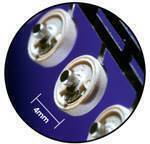
Another key ingredient for any micro-molder is the ability to perform other traditional injection molding processes at the micro scale. The demand for micro-sized lead frame and insert molding continues to grow and the same size and tolerance requirements of standard micro-molding apply to these processes as well.

The ability to overmold a micro-sized part on an extremely small insert while maintaining consistency and accuracy is critical. This process is in demand for the continued success of the micro-electronics and semiconductor industries.
Insert micro-molding applies to more than just metal inserts. It means being capable of molding in and around a wide variety of other materials such as ceramic, glass, fabrics, film or foil to other plastics.
The image to the right is an example insert molding on the micro-scale. This particular example shows a special fabric insert material carefully positioned at the center of the part. To successfully feed, cut, position and shut-off on this unstable and delicate material the mold has to be very precise. The molding process required repeatable control to avoid damaging the insert while keeping the tight tolerances of the part itself.
2-Shot Micro Molding

2-Shot Micro molding
Adding to the capabilities of micro molding is the ability to mold two different materials on the same part at the same time. The two different thermoplastic resins are shot in sync so that it requires only one mold cycle. Often times this process can add valuable cosmetic or functional properties, reduce labor or assist in making the part more robust.
The image above has a soft durometer material in the center, surrounded by a hard ABS structural material. This part is molded in one mold eliminating the need to build two parts and assemble them or two tools and insert mold one material on the other saving time and resources.
Micro-Optics

Micro-optics molding is a precision injection mold process that produces optical components on a smaller scale than is attainable than with traditional molding techniques. Due to the overall size and detail, part tolerances are measured in microns. Parts of this nature take the form of connectors and sensors, and are used in illumination, optics, and imaging. Micro-optics molded components are often used in very small medical, data-com and wearable devices.
In-House Micro Molding Tooling & Production

Control of the mold design and build process is essential to the success of any micro-molding project. Having in-house tool design, build and maintenance resources is a significant advantage when dealing with extremely tight tolerances and complexities of the parts we have already mentioned. The end goal; making good parts on time every time requires experienced in-house tooling, design engineering, project planning, process engineering and quality engineering resources. This assures a fully developed design for manufacturing. It would be very difficult to outsource these responsibilities with manufacturing projects this complex. The in-house tool makers are integral members of the project management team as are the quality technicians and process engineers. The team must plan and execute many sophisticated production processes while maintaining strict project timelines. The need for clear on-going communications all along the way is essential. In-house resources also play a critical roll in routine maintenance, running product changes or repairs that may be required. Success is never guaranteed but probabilities increase dramatically when project and production planning, timeline and execution responsibility all lie within the control of a single entity.
Automation & Packaging

Part handling and packaging sometimes seem like a second thought, but in many cases, it’s almost as important to the process as making the part. Molding a small part is one thing. Molding it and packaging it so it’s oriented in a manner that’s useful to the customer can be a challenge all on it’s own.
In-house custom automation and packaging can come in many forms. This can be reel-to-reel packaging, light subassemblies, lead frame die-forming and singulation, in-line inspection or a wide variety of other custom secondary processes. These added services complete the total micro-molding service and sometimes can be the difference between project success and failure.
Quality Assurance

Quality assurance is imperative to any micro-molding operation. The ability to prove that parts are made to spec time and time again is where true capabilities are tested. This assurance comes in various ways.
Quality begins at the start of each project. Design for manufacturability reviews are performed to ensure the project is off on the right foot. Considerations for quality, the robustness of the process and the ability to inspect and measure happen as early in the process as possible.
From there control plans addressing critical features, FMEA results and other quality requirements are developed. High tech and low tech measurements are used depending on what’s appropriate. Measurement plans using precision gage pins, high-resolution in-line vision systems may be employed where necessary. Verification of tool dimensions as well as finished part dimensions often requires high magnification microscopic measurements.
Product handling is also a necessary consideration. Surface contamination can be at a minimum a nuisance for parts this size. Delicate features need proper processes in place to make sure the product arrives to the customer undamaged. Automation and clean room molding may be required.
Materials Best for Micro Molding
Micro molding materials come in almost as many forms as there are ideas in the mind of a Mechanical Engineer. In the world of micro-molding, mission-critical components often require exotic or highly engineered compounds.
Materials like PEEK, PEI (Ultem®), carbon filled LCP or glass filled nylons are commonplace. Soft durometer or elastomeric resins are also prominent. Direct experience with these materials in the context of micro-molding is another part of valuable know-how needed to maximize the performance of the resin/part design combination.
Two column shortcode

Customer Satisfaction

Customer Satisfaction
When it’s all said and done it’s about the finished component or assembly. An authentic micro-molder produces extreme parts consistently and efficiently every time. A true micro molder is ultimately there to meet the high demands of modern manufacturing. The artistry and ingenuity in the process is lost if, in the end, the product does not satisfy the customer.
Even though micro molding may seem new and novel, Accumold has been in the “micro” business for more than two decades and have produced billions of micro molded parts over the years. It’s where we started as a company, and it’s where we continue to grow, innovate and produce.
True micro molding is our way of thinking, our way of doing, and our way of life.
Please reach out today if you have questions!
Two columns – text-btn / Img
Iowa Learns™ is a Work-Based Learning model for Iowa high school students based on federal law that provides a student learner exception for certain hazardous occupations – 29 C.F.R. § 570.50(c). It represents an early entry into the workforce.
Iowa Learns™ is a partnership between Accumold and DMACC. It encompasses one of DMACC’s Work-Based Learning initiatives and will involve a working partnership between high school students, parents, the College, school districts, and Accumold. The goal is to give students the opportunity to explore paid career opportunities and grow Iowa’s skilled workforce.
To learn more about Iowa Learns™ and the open positions with Accumold, please visit the program’s website.
Available positions within Accumold can include Process Technician and Quality Technician. These positions include job shadowing and assisting a full time Process or Quality Engineer or Process Technician to coordinate the process, methods, and sequence to produce injection molded plastic parts.

Map Section
Where We’re Located
We are located 3 miles north of I-80, approximately 0.3 mile east of Interstate 35. From Des Moines, we can be reached by taking exit 90 from I-35 North, taking a right on S.E. Oralabor Road, and looking for our building on the south side of the road.
Contact us

Contact Us
1/2 Text 1/2 video
Accumold Story
Like many great start-ups Accumold® began operations in a rented garage. Our founders discovered there was a growing need to manufacture small and micro injection molded components that went well-beyond the available molding systems of the day…
Micro-Mold® Parts
Micro Molding – The science of small parts
Micro molding is the essence of what we do at Accumold. We started our company on this exacting manufacturing process and it remains at the heart of our operation today. Parts made with our Micro MoId® process range in size from just microns to a half inch. These components often have complex geometry and very tight tolerances-with no margin for error.

Micro Mold Alignment Spacer
Description: This part is made of LCP and is Accumold’s smallest commercial part to date. It measures 800µm x 380µm x 360um. 144,000 parts weigh 1 oz. Part handling more of an issue with this part than the tool build and production.
Material: Mineral Filled LCP
Market Segment: Micro Electronics Molding
Core Group: Micro Mold® Parts

Micro Mold Rotor Pinion
Description: This is a two-part assembly. The first part (the black ring) is a magnetic material molded in a plastic compound containing metal. The second part is a partial glass filled Polysulfone. We take the black ring and mold around and through it to create the assembly. Tolerances are very tight. This part must be individually packaged for protection.
Material: Polysulfone with Glass
Market Segment: Emerging Technologies
Core Group: Micro Mold® Parts

Micro Mold Gear
Description: Incredibly precise micro molding produces this part, with 18 teeth around the .092″ (2.3 mm) diameter and a concentricity call out of .0005″ (13 µm).
Material: PPA
Market Segment:Micro Electronics Molding
Core Group: Micro Mold® Parts

Micro Mold Star Wheel
Description: Considering it is unfilled material, this part has very tight tolerances. Very little flash is allowed on this part because the profile tips are bearing surfaces.
Material: ACE-Delrin 500CL
Market Segment: Automotive Electronics
Core Group: Micro Mold® Parts

Micro Mold Tip
Description: This part has a .010″ (.25 mm) hole that must be a clear and free of voids and bubbles. The thin wall section is .006″ (.15 mm), make it very challenging to fill with acrylic.
Material: Acrylic – clear
Market Segment: Medical Micro Molding
Core Group: Micro Mold® Parts
Micro Optic Lens
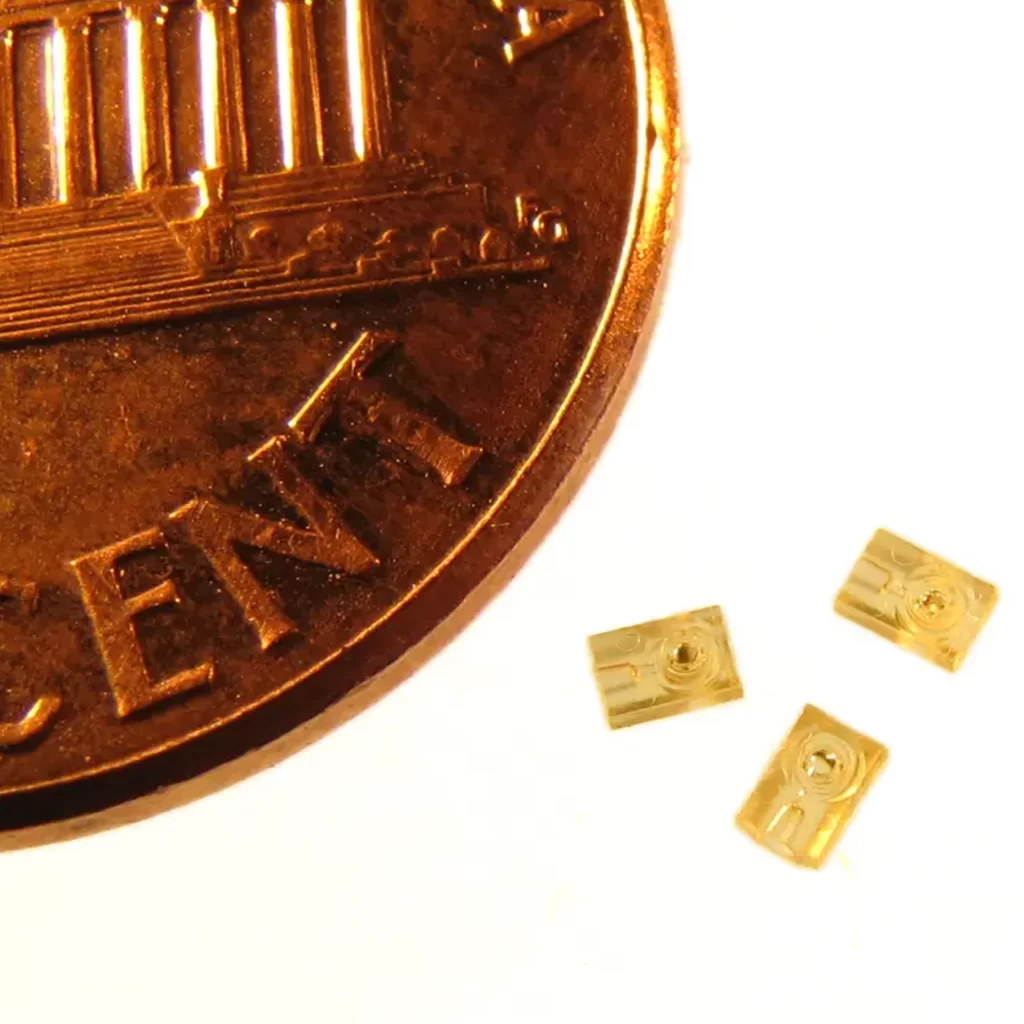
Description: This UItem® part has a 100 µm diameter aspheric lens and a 125 µm base radius with a 3 µm tolerance that is critical to a part functionality. Dimensions of the part are .700 mm x 1.00 mm x 1.700 mm.
Material: UItem®
Market Segment: Micro Optics
Core Group: Micro Mold® Parts

Micro Mold Shell
Description: This part is a housing for a tantalum capacitor. Its dimensions are .036″ (.91 mm) x .038″ (.97 mm) x .073″ (1.85 mm), with a .0085″ (.215 mm) hole diameter and wall thickness of .004″ (101 µm).
Material: LCP
Market Segment: Micro Electronics Molding
Core Group: Micro Mold® Parts

2-Shot Micromolding
Description: The hard, clear ABS part is combined with the soft, white TPU material to create a perfect bond. This process saved manufacturing resources and replaced the assembly and gluing process.
Material: TPU & ABS
Market Segment:Medical Micro Molding
Core Group: Micro Mold® Parts
2/3 text – 1/3 cta
Accumold micro molding specializes in producing extraordinarily small plastic parts that require extreme precision. And we’ve been doing it since 1985. The micro molded parts we manufacture are commonly measured in microns. We also produce small-size parts with micro features, mold in and around existing components, and create components using intricate lead frames or inserts. We devote these specialized capabilities to every order-delivering our services with important extras:
- Consistent, repeatable production quality
- Scalable volumes, from prototypes to millions-or billions-of parts
- Efficiencies that lead to affordable pricing
- Decades of experience and expertise
- Unparalleled industry longevity

Design Guidelines
We stand alone when it comes to extremely tight tolerances and small micron sized features. Our design guideline page is updated often as our technology continues to advance.